
There’s No Way to Know
Praise and Reviews
There’s No Way to Know immerses us in 1970’s Tanner’s Gap, a fictional West Virginia mountain town, unwittingly living out the sunset moments of a fading away life. The deeply-felt and richly-detailed stories intertwine and speak to each other through the shared landscape, the generations of rich social connections, and the curiosity of occasional newcomers.
Jody Hobbs Hesler, author of Without You Here
From the gossiping quilters to the young women with dreams of taking over the local diner to the high school basketball star who just wants to get out of the town, Hostetter has woven these unflinching stories together with lyrical threads of loss, jealousy, and loneliness. These are the men and women who stay, who leave, who are left behind, and I promise when you get to the end, you’ll want more.
Clifford Garstang, author of In an Uncharted Country
Through sharp dialogue, evocative images, and an understated tone, Hostetter explores themes of marriage, parenthood, aging, rebellion and faith—the result is a tender and thought-provoking portrayal of life in the South.
Kristen-Paige Madonia, author of Fingerprints of You

Plain: A Memoir of Mennonite Girlhood
Praise and Reviews
“This quietly powerful memoir of longing and acceptance casts a humanizing eye on a little-understood religious tradition and a woman’s striving to grow within and beyond it.”
from University of Wisconsin Press Catalog
“The prose is sharp and evocative…, and Hostetter’s searching account of wrestling with her faith resonates. The result is an excellent meditation on faith and community.”
Publisher’s Weekly
“These moving, tenderly rendered essays straddle the line between Hostetter expressing a fervent desire to leave her upbringing and way of life, while also finding pride and nostalgia from where she came from. The two pathways ultimately merge and come to reflect how Mennonite influences will always infuse Hostetter’s being. Readers are the blessed beneficiaries of her early formations and experiences, as without them, she would not have become such a sensitive, perceptive and wise writer”
Kathleen Gerard, Shelf Awareness
“Plain is filled with engrossing details…while Plain recounts Hostetter’s emergence from her upbringing, the memoir is balanced by its innate appreciation of Mennonite culture. Engaging and reflective, Plain is a complex memoir about moving beyond the Mennonite faith while maintaining an integral connection to its lessons.”
Foreword Reviews
“Hostetter’s writing is lovely and evocative of place and emotion. Readers will enjoy sinking into this quietly empowering story of coming into one’s own.”
Booklist
“This memoir is a deeply honest, forthright, and forgiving account of finding her way as a gay Mennonite. Plain shows how we the misplaced faithful take the truths of our upbringing to create beautiful stories, homes and lives.
Joanna Brooks, author of The Book of Mormon Girl
“Plain is a wise and wonderful memoir about breaking away from tradition, then finally discovering its value. This clear-eyed yet affectionate coming-of-age story will resonate with anyone who has ever struggled to separate from their family and find their true, authentic self.”
Sharon Harrigan, author of Half and Playing with Dynamite
“If you enjoyed Mary Alice Hostetter’s delightful Modern Love essay in The New York Times, you will absolutely love this book. Filled with a familiar equanimity, grace, and droll humor, this book is as simple and nourishing as fresh vegetable soup and as complex as a Tibetan mandala. It will leave you pondering the depth of a single word: plain.”
Shirley Showalter, author of Blush: A Mennonite Girl Meets a Glittering World
See additional reviews
*****

Available from Amazon.com
The Measure of a Life: Diaries of a Mennonite Farm Wife 1920-2000
From The Prologue:
My mother, Ruth Martin Hostetter, began keeping a diary when she was fifteen and living on the family farm in Cattail, Pennsylvania with her parents and seven siblings.
…
I have often wondered why at the end of each of her busy days, days of work in the fields, in the garden, in the kitchen, with stacks of dirty laundry and dishes, eggs to gather, peas to pick, cows to milk, twelve children to feed and care for, why at the end of each of those days did she sit down at the desk and write in her diary?
I once asked her, and she answered, simply, “To keep track.” And that is what she did. She kept track of dozens of this and bushels of that, and bunches and buckets and bales; and quarts and crocks and lathes and shocks. She noted how many workers she fed when they came to thresh or fill silo. She recorded what pies or cakes or puddings were made in preparation for Sunday dinner, how many gallons of milk were returned when the pole cat got in the milk house. She noted the ever-changing price of eggs, the cost of shoes, how many souls were saved at the revival.
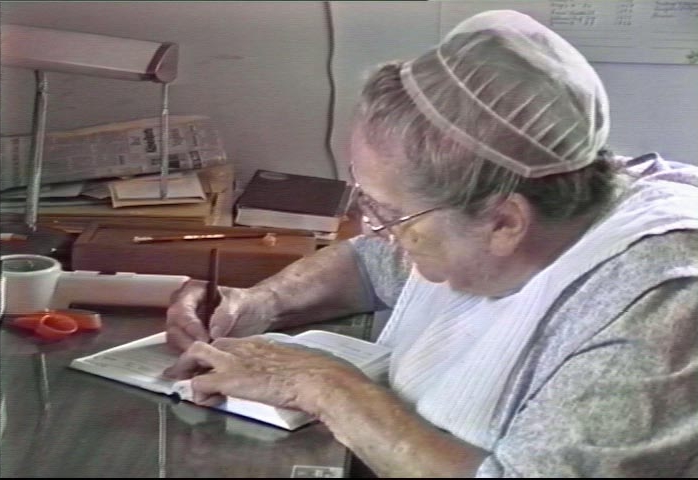
Ruth Martin Hostetter